Tuesday, January 10, 2012

Beware the Big Bad BlueWolf: How to lose customers in 4 easy steps


This is a true story. The names of the company, BlueWolf, has been changed to RedChihuahua in order to, hmmm, who cares.


Step 1: Misrepresent and Overpromise

BlueWolf RedChihuahua, a company claiming to specialize in database administration and consultation, contacted us at Lifesta to see if we needed their services. The BlueWolf RedChihuahua rep assured me they're expert at Amazon RDS databases, the type we were using.

We decided it wouldn't hurt to have someone review our databases and suggest ways of improving them. We signed a contract for 4 hours worth of work to review database performance and suggest improvements.

Step 2: Ask the customer how to do your job

Over the next couple of months BlueWolf RedChihuahua tried to access the database and configure it in order to do the review. Mostly it involved sending us incorrect instructions, asking for types of access that the RDS instances just don't provide, or telling us why it can't be done with the database we're using and would we consider upgrading? They can help…woof woof woof

Quick google searches showed that a) yes it can be done and b) you don't need to upgrade the database and c) BlueWolf RedChihuahua didn't have a clue. Ok - the last one didn't come up in the search. Maybe now it will.

(attention google search robot: BlueWolf doesn't have a clue, databases, bad service, review, unhappy customer)

In an ironic twist I had to keep sending them instructions on how to do their job and tell them where they're wrong.

Step 3: Bill the customer for your ineptitude

One day, an invoice arrived from BlueWolf RedChihuahua.

At this point BlueWolf RedChihuahua is still trying to enable logging in our database in order to figure out performance. So far, they weren't able to find the right "expert" in the company that knew how to do this. They also obviously didn't try google.

The bill was for "research and communication"*. They "investigated" and "communicated" how to do their work. Imagine our surprise. They haven't yet started the work we've contracted them for!

We challenged the bill, talking to the sales rep and emailing BlueWolf RedChihuahua management, explaining all this. There was only a short reply from Michael Kirven, one of BlueWolf RedChihuahua's co-founders. It read:

From: Michael Kirven michaelk@redchihuahua.com

To: me, Erika, Richard, Laurie, Iwona

Please file in small claims.

Thanks,

Mk

Naively, we figured at this point we're all going to slink into our respective corners and lick our wounds chihuahua-style, forgetting this unfortunate incident.

Alas, it was not to be!

Step 4: Cementing the relationship, mob-style

They sued us. Really. For $350, the bill we refused to pay. They actually sued us for it.

Let's put this in perspective:

- You hire an expert mechanic to tune-up your car

- The mechanic can't pop the hood, but keeps telling you to rub the antenna, squint at the windshield and in general "tickle under the side-mirrors - cars are ticklish and the hood will pop"

- He suggest that you trade-in the car for a better model. He can help...woof woof woof

- He then bills you for "research on how to pop car hoods"

- Then sues you when you refuse to pay

They say any publicity is good publicity, right BlueWolf RedChihuahua?

Beware the big bad BlueWolf RedChihuahua!

---------------------------------------------------------

Extras:

* Image taken from http://kallangroar.com/prime-league-youth-football/3174-sea-games-2009-semifinal-singapore-vs-vietnam-31.html

* The invoice was for: "research and communications re: slow query logging Investigated and communicated ways to enable slow query logging in RDS. Provided steps, resources and client communication."

* Yael, my business partner, send this email to Michael Kirven. We received no reply:

Subject: Before going to court

Dear Mr. Kirven,

I'm the CEO of Lifesta. We've engaged your company to perform a review of Lifesta's database in May 2011.

The project deliverables as detailed in the SOW are as follows:

- Examine 10 top slow queries and make recommendations on increasing performance (2 hours)

- Examine and make recommendations around indexes depending on top 15 queries by activity observed (2 hours)

While Lifesta's CTO, Eran Davidov, has been trying to help your team get access to our database, he has been surprised to discover that the team doesn't have the first idea about working with an Amazon RDS database. He has spent multiple hours exchanging emails and phone calls with your team effectively teaching them to access that type of database. Even more surprising was the bill we received at the end of June for 2 hours of work, which to our knowledge did no go towards any of the agreed upon deliverables.

As the 2 hours of work produced neither deliverable, partially or in full, and in fact cost us expensive work time, we asked for a clarification regarding the status of the work and which deliverable these hours were billed towards. We have heard absolutely nothing back. Multiple emails and voicemails left to your team members have produced no response except your reply to one of Eran's emails in which you asked your team to file a claim in small claims court, and subsequently the subpoena to appear in court.

I have spent many years in client services at McKinsey & Company and Sun Microsystems, and never have I seen a client service company choose to sue their clients before speaking to them. We are more than happy to discuss the situation and reach an agreement that is acceptable to both sides outside of court. As the founder of a client service organization I would assume that would be more agreeable to you as well than seeing your customers in court.

Thanks,

Yael

Friday, October 22, 2010

Simplicity

(cross posted to http://blog.lifesta.com )

Engineers are not great product designers. There - I said it.

Programmers are conditioned that way, but most people tend to over-do designs. We grow up with choice and believe more choices make our lives better. That's not usually the case. Things that are simple to use are easier for people to understand and use, easier to explain, easier to sell. This doesn't mean they're simple - think of the iPhone's one button. There are a couple of others hidden away, but there's just one button you use to get its attention, go back to start, navigate.

Programmers are conditioned to over-complicate things because that's what they see when they start writing code. Programmers use components called API to write their applications. API make up the basic capabilities of the system they write the application for. Think for example of the ability to put a pixel on the screen, to draw a line, to make a sound. They all make themselves available through API (application programming interfaceS). The thing with API is that they are usually built to support a lot of things the programmer might want to do. For example do you want the line to be smooth, or jagged. Should it have round edges, or pointy ones, or maybe arrow-heads? Is it a dashed-line? what dash pattern would you like?

So much choice!

To show you how the thinking goes, let's "design" a website to tell people about the weather. What would we need?

We want the user to tell us where they are. They can use a zip code, or an address, or point on the map, right? Whatever is more convenient for them.

Then we want to show them the weather today. That means the temperature and the chance of rain or snow.

Now uncle Bob has rheumatism and he feels it in his bones when the humidity is high. Let's add humidity so the rest of the family can check up on him.

Our temperature is in farenheit, but we've got some foreign friends that came to the US and still think in Celsius, so let's give them the option to see the temperature on that weird scale.

And auntie Jane wants to know the hour-by-hour forecast so that she can know what clothes to pack for her trip to the store.

And cousin Jim wants to know what tomorrow's going to be like, so let's give him the option to see the forecast tomorrow and for the rest of the week.

Tada! We've described the swiss army knife of weather applications, something that's all things to everyone. Difficult to use, difficult to explain, and just how would you tell users why you're different than weather.com?

Now let's look at a minimalistic design for a weather app. Let's say we don't want to serve the entire world, but rather find a core set of users that will really really like our service, and will be able to explain it easily to their friends.

The folks at Thoughtbot have done just that - http://www.UmbrellaToday.com . The service was put together by Thoughtbot, a ruby-on-rails shop, to showcase simplicity. The service does one thing and one thing only - it sends you an email in the morning if (and only if) you need to take an umbrella with you today. It's extremely focused - it serves those people (like me) who need to know if it's going to rain on them or not, so that they can grab the umbrella on their way out the door. It won't serve aunt Jane or cousin Jim, but it will cause fans like me to use it and tell people about it.

So what do you need to do to use it? enter your email, your zip code, and the time of day you want to get the email. That's it. No options, no selections, no different views. It either works for you or it doesn't - it's that simple. And most developers will not be able to design something like this.

Would you?

Friday, June 25, 2010

The Land of Dreamers

My partner Yael and I have a notebook with ideas for new products, services and other things that could become startups.

To understand this statement and why it makes me shudder, I need to tell you a story first.

The Fall

We've just launched http://www.lifesta.com. Our original startup idea for auntieChef, the food-from-people-that-care-to-you-marketplace is not panning out. It doesn't really matter why (ask me if you really want the whole story) but we've decided it's not the right way to solve the healthy / better food at home problem.

After spending a few weeks agonizing about how to solve it in other ways, how to kickstart the business in more innovative ways (at some point we were talking about becoming a virtual restaurant to an office building - don't ask), we've finally hit on a direction that might work.

Excited, we went home for the weekend (meaning two of us stayed in NY, the third went home to Boston) and reconvened on Monday. A few hours of a very downer conversation ended up with our Bostonian partner deciding that he doesn't want to continue.

We spent a couple of weeks recovering from this, and working through our idea to see how we would build it. We ended up deciding that no, we don't really think we can make it happen.

So now we had a startup, two founders and no idea.

The thing is, there are two types of people: execution people and idea people.

And both of us are execution people.

Yin and Yang

The execution people take an idea, latch on to it and move forward, going around obstacles, changing parameters to solve problems that come up.

I'll call them executioners. (yes - I know what it means, but the point is - move forward, slay problems, get it done).

Idea people are better at the random, out-of-the-blue idea.

I'll call them dreamers.

Executioners will say: The user has a problem with the login page? no problem - we'll move things around, simplify, they'll only have to provide a password and we'll figure out the username, etc.

Dreamers will say: The user has a problem with the login page? Let's have them call in instead of logging in. Let's do an anonymous service. Let's sell raw ingredients and have the people cook their own food, so we don't need to know who they are. Let's leave the food outside so people can come pick it up without telling us who they are.

Both are critical to the team, but their jobs are very different.

What's also interesting is that if you put a dreamer and an executioner together on a team, their roles will get even more polarized. Dreamers will provide the wilder ideas, executioners will censor, narrow down, focus the ideas.

One of the ways to recognize dreamers is that they have a notebook full of ideas.

Notebooks Notebooks Everywhere

In one of those startup meetings that lots of startup people go to in order to network, hear what others are doing and provide criticism worded in the form of polite feedback, we met Liam. Liam, a very nice guy, heard that we're in flux and offered to share an idea with us.

What evolved over a series of meetings was one of the most bizarre, entertaining, flabbergasting, and all-around blog-material-generating set of conversations I've had in a long time.

Liam had an idea that sounded very interesting and seemed to have potential. Since all startups are about building a company that will last and change the world, and not remotely about the most relevant exit in the form of an IPO or a sale, let's call this idea The Magic Money Factory(TM) (no illegal money counterfeiting implied).

After a couple of days of thinking about The Magic Money Factory(TM) we decided that we're interested in pursuing this a bit more. We set up a meeting with Liam and asked him what he had in mind for us to move forward.

He outlined that because he's bringing in the idea, and has a lot of relevant connections, he wants 40% of the company (we get the rest) and he wants to be vested immediately, like an investor. For the non-startupers of you, this means that while we'll have to work through a few years to earn our full share, he owns his immediately, even if he doesn't do anything else from now on.

Let's analyze this a bit:

- An idea is important. In fact, an idea is a critical piece of starting a company. It's like the grain of sand that gets embedded in an oyster, and starts the pearl creation process. On the other hand, most startups end up with a different product than what they started doing, because once you start talking to customers, working through issues, etc. you'll find that you might have identified a problem, but your solution is wrong, or even that the way you described the problem is wrong. A bit of internet search will show that ideas are valued as 1-5% of the company, the rest is execution. After all, a pearl is not a grain of sand, and the iPod is not an "easy-to-use MP3 player".

- The connections Liam was bringing to help The Magic Money Factory(TM) were, to stretch the allegory a bit, not money people, but cotton people. (US money is printed on a cotton / linen combination). So yes - they had some relevance, but were not really the people we needed.

We tried to explain that between the two of us, we have a lot of experience in management, releasing products, marketing and executive exposure, but to no avail. Liam said that this idea is much better than a lot of other ones, and that he should know.

He's got a notebook full of ideas at home.

Leggo my Ego

He made it clear that this conversation was about business, not about ego.

A few minutes later he said "The reason I'm asking for 40% of the company is so that you show me that you believe enough in the idea that 10% here or there won't matter to you."

"Doesn't that work both ways?", we asked.

"Yes", said Liam, "but it's important for me to own 40%".

I'd like to point out that some ego is being harmed in the making of this blog entry.

The Piss has Gone to His Head

And so we went home and sent a polite refusal email saying that we can't accept those terms.

A few days later we got a message asking to meet again, to see if we can reach some agreement.

After some chitchat (as I said - Liam is a very nice person), we got down to business. The new offer was a 33% split each way. There was also a commitment to work with us on this project throughout, and a provision that if Liam leaves or stops working full time on this, his control stake would drop (though not his part of the money).

Once more we were treated to how this idea is better than most:

First of all, it's not an idea, it's a "concept". Liam's definition is that apparently while everyone has ideas, this is a thought-out idea. And concepts are worth more. oh yes.

Second, this idea, sorry, this concept, is like an autobot: it's a car AND a robot. It can transform. It can start as a business making money, THEN become a startup getting funding. It's the swiss-army-knife of concepts. The elusive unicorn of concepts. It's a UniConcept(TM).

(remember - he has a notebook full of ideas at home. He can tell!)

The thing is, to catch a UniConcept(TM), you need a virgin startupper, commonly known as The Fool(TM).

Then we tried to understand why a person who pretty much professes to work less on the project deserves to own 33% of it. Once you start working on a startup idea, you've got no time for anything else. You focus on it, make tweaks, do everything needed to make it work.

Liam promised he will work with us full time on this idea.

I should probably explain a bit about Liam. This is how he presented his life story to us:

- He finished his BA from a good school, then thought about what to do with his life.
- He then started his masters in two fields, but didn't finish.
- Then he was accepted to a very prestigious economics PhD program, which he didn't finish.
- Then he started a company with a partner but they had a falling out and they, well, didn't finish.
- And he's been working on a different idea for the past two years which, to be fair, he never quite started.

So Liam doesn't seem to have the staying power. We could pretty much predict that after a few months he'll drift along to the next idea. He acknowledged this, but said he'll commit to showing up at the office. I can already foresee the annual performance review conversation: "But I'm in the office 9-5 every day!"

He then said the thing that killed the deal for us: even if he only commits 30% of his time to the project, his contribution is going to be as powerful and meaningful as our full time.

So there - a guy with no credentials is absolutely certain that he's better than us. Isn't that nice?

Did you wonder what the "Piss has gone to his head" title meant? It's a literal translation of a Hebrew expression that means that someone is swollen-headed, has grown too big for his breeches, is self-important. I like the piss metaphor better - it explains the actual physical process that happens when you're too important to take a piss.

As for me, I'll have a problem working with people who have notebooks full of ideas. It seems like those ideas rarely get translated to reality.

The Liam Strikes Back

There were a few other Liamism jewels sprinkled throughout the conversations. For example, he said he could probably get Ben Bernanke to be on the advisory board. You don't get it? He's sort of the head of the competition for Magic Money(TM). Oh never mind. You just don't get it.

"I can prove that this concept works very easily", he said. "All I have to do is grow a potato in a glass of water in my kitchen". We weren't quite sure how that would prove the point, so he explained: "it's almost like growing cotton, which is the first step to making Magic Money, sort of."

We had one final call with him, since he wanted to hear our counter-offer before we close the negotiations. To be fair, he was trying to be creative and come up with other ways of structuring the deal to get us on board, except we had our best offer defined and would not budge.

"I'm disappointed you weren't more creative. For me.", said Liam.

The Notebook

And so we went back to the drawing board, thinking up ideas for startups. No - not concepts. We're not smart enough for that.

What surprised us was that in a few short days of, admittedly intense, brainstorming, we came up with quite a number of ideas. It seems that if the dreamers are not on the team anymore, the executioners can actually come up with ideas. Maybe it's all the quiet that's causing us to speak up and fill the void.

We started writing them down in a notebook.

But it scares me. I'm not sure I can work with us anymore now that we have a notebook.

Eran

P.S. The name Liam is obviously not his real name. Liam = Living In A Movie

Technorati claim code: DUTHC9SNVRAD

Saturday, March 20, 2010

Re-Coining a Term

But first, a request

Please help us out and fill out this short survey. Tell your friends about it too if you can:


or the short URL: http://bit.ly/9Lap3l

Thank you!!!

Re-Coining a term

We found the the holy grail! We were walking down one of the aisles of the show and there it stood:


It's the perfect gift. It makes for an excellent story. It even leads itself to a picture and a puzzle.

Can you guess what it is?

1000 Foodies, but only Food Court Chow

As part of our continuing education into the food business, the auntieChef team went to our first professional conference. I've been to a a number of conferences in the past, both as an attendant and as a booth worker. All of these conferences were technical in nature, whether for electronics or software. This one was different. The International Restaurant & Foodservice Show of New York had the same format of rows upon rows of booths with companies showing their wares, but in this case the wares were food. And you got to sample their ice cream, mango liquor or fried squid.

The show is the place where companies showcase their food, machinery or other services for the restaurant business. For example, if you were looking for commercial quantities of Soy or Green tea or specialty Wasabi or silverware for your restaurant or prize Wisconsin Cheese or Organic Pork or prime beef or chef's knives or flat bread or even a company to do the interior decoration for you, that's the place to find them. They were all there, and you got to sample the Wasabi or Fortune cookie. But not the interior designer.

And the only food to buy was in the Javitz Center's food court. Kind of ironic, that.

And walking down one of these isles is where we found the holy grail, the can that generated a few days of gratuitous jokes, the can that will re-coin a phrase, the little can that could!


Any guesses so far?

Hint - the back of the can has a green star that looks like a quality seal. Looking closely you find that it was approved by one of the US veterans associations!


Recruiting Chefs

Last week we visited the French Culinary Institute's career fair. The school runs intensive accredited cooking classes of 6-9 months, specializing in either French cooking, Italian cooking or Pastries. A couple of weeks back we did a tour of their classrooms and kitchens (4-5 separate ones) and were very impressed. The career fair is where students and alums of the school come to meet restaurant owners and HR reps from restaurant chains who are looking for cooks for their kitchens.

I couldn't help but contrast this fair with the the ones I was used to in technical schools:

First, this is a culinary school. The school has a restaurant (L'Ecole), that lets the students try out a real restaurant setting. They work in the kitchen while a professional staff mans and womans) the front of the restaurant. As recruiters in the fair, we were invited to a free lunch. All I can say is - exquisite. French food done well.

Then, there was a distinct power structure to the fair that's not as visible in tech fairs. In a technology fair, you'd go up to a recruiter, take a seat (or you'd both stand if there aren't any seats) and talk to them about what you want to do, while the recuiter will tell you about the company.

Here, all of us recruiters sat down around the room, while students and graduates circulated and gave their resumes to the interviewers. There was a clear distinction between the sitting-down employers and the supplicant students standing trembling before them. We were surprised to see that we were the only people (at least in the room we were in) that would stand up to talk to the students.

We were also the odd-company out since we weren't really recruiting anyone. We were there to tell them about our site and encourage them to check it out and sign up.

The students we talked to were fascinating. There's no fixed age, since it's not a typical post-high-school college. For many of the chefs it's a second or even third career. We've met the guy who cooked since he was little, the woman who was an actress, then an administrative assistant and is now a chef, and the ex-MBA come consultant that decided cubicle life is not for him.

If you're in town, check out the restaurant, L'Ecole.

To Re-coin that term

And now, back to our restaurant show discovery: Introducing, drum-roll please, Canned Bread.

Yes bread.

This Japanese company has found a way to can bread. It stays "fresh" for 3 or so months and comes in a number of flavors.
They are looking for ways to market it, and their posters had such awesome suggestions as "for survival", "for long hiking trips" and "great as a giveaway at shows". We took one. As you can see - it was a great giveaway at the show :)

So remember - it's "The best thing since Canned bread"

And Please...

Fill out our survey and pass on the word:

Monday, February 08, 2010

The Skepticism of Rats

(Cross-posted to http://blog.auntiechef.com )

Here's an exercise in creativity. How would you start the following sentence?
"..., as rats are very skeptical of new things."

Yes, it's a real sentence I came across. Seriously. Stop for a second and think about it. What would be a good opening for it? Here are some of mine:

  • Don't try confidence games on rats, as rats are very skeptical of new things.
  • The newest fashion is wasted on rats, as rats are very skeptical of new things.
  • Rats haven't moved from myspace to facebook, as rats are very skeptical of new things.

If you've got good ideas, add them as comments to this post.

I'm taking the New York City online Food Protection Course, a course that all supervisors in restaurants and food establishments must take. This is not a backup career choice. It's a way to understand food safety better, and get a feel for what our Aunties (the internal nickname for sellers on auntieChef) have to go through.

Imagine my surprise as in the middle of this dry material about the proper way to wash dishes (you're all doing it wrong) and why that lasagna in the fridge must not be placed under the thawing chicken for tomorrow's dinner I suddenly come face to face with the very skeptical rat comment on the food safety course:

"Do not set up traps for several days to allow rats to become acclimated with the traps, as rats are very skeptical of new things."

This is so much more than rats just plain avoiding new things.

Imagine you're a rat, snooping around, minding your own business when suddenly, there's this new thing you didn't see before? You immediately rush to your friends to have a debate about it:

- Rodney, you there?
- Yep George. What's up?
- There's this new thing up there. Not sure what it is. Waddaya think?
- Hmm. New thing? What new thing?
- This thing, Rodney. This square thing with other thingies on top of it.
- Hmm. I'm not sure George. I know! We'll send Kenneth to check it out. He's gullible. He'll try anything.
- Hey Kenneth! Kenneth! Come over here a sec, we've got something for you to try. It's really cool.
- What is it Rodney?
- See that thing over there? It's a new Rat game. Go ahead - try it out. Jump on it a few times. Food will come out.
- Cool! Let me take a running leap and j...
- Well George, now we know. Stay away from it. I knew not to trust these new things.

Or maybe it means rats don't like change?

- Hey George, we're planning tonight's run. Your path is through there, as always. Just go around that new thing there.
- But we've always run that part straight, Rodney. It's the way we've always done it. Why should we change now? If it ain't broke and all that.
- Well George, would you believe it's because the competition is coming out with a new business model that will cause our sales to drop? No? Ok - just run it the way we've always done it.
- Hey Rodney, it's not a probl...

Well, off to the next chapter in the course where I'll find out which diseases can kill me when I eat at restaurants.

Don't forget to comment on this post, as rats are very skeptical of new things.


Saturday, January 16, 2010

The Land of the Cooks


New Beginnings

I'm on a life-changing trip. One of my managers once told me that when reorganizations happen, you have to look at two things:
  • Is your manager still the same?
  • Is your job still the same?
If none of these changed, you probably won't feel the impact. If only one of these changed, you have a base to build from, but if both changed, you have to pay attention.

After 12 years at Sun, where I've gained most of my professional experience, I've decided it was time for, as Monty Python put it, Something Completely Different (SCD).

And so to make sure there's never a dull moment, I've changed my job, my boss and the place I live in.

SCD I - A Tale of Two Yaels

I am now living in New York City, the Big Apple, Gotham, the City that Never Sleeps...

Over the years, I've moved to progressively larger and slightly more expensive apartment, starting with the 5-people-in-a-dorm-room I had during my army service. That all changed when I moved from Israel to the US, got an apartment with one room less but 4 times the rent.

New York did that to me again - one room less, 25% more rent. Amazing!

The apartment hunting was very educational. I focused on Manhattan's upper east side for a location. The first set of apartments, let's call them "discount apartments", had what you might call character. For example, one of them had a bedroom connected through the living room. Both were about the size of my couch. The agent insisted that two
(2!!!)
couples lived in that apartment. I can only assume some sort of open relationship. I can't imagine going to get a glass of water in the middle of the night and having to check if there's a sock on your own door and you can't leave.

I found another apartment for rent posted on a sign outside a building. Calling the number on the sign I asked if I can move in a month later. The agent said "by now, it shouldn't be a problem". A small warning light went off in my head, but still - a cheap, 2 room apartment. Worth checking, right?

We met the super (short for superintendent) later that evening and he walked us up a flight of stairs. "We" is me and my local expert, YaelG, who probably hates the public mention and won't speak to me for a week, but thank you for all the help! We walked up a couple of flights of stairs. Some of these steps noticeably sagged under me as I climbed.
A small warning light went off in my head, but still - a cheap, 2 room apartment. Worth checking, right?

We then followed the super to the apartment at the end of the hallway. I was getting a slightly claustrophobic feeling that the walls were closing in on me, and indeed by the time we reached the door, my shoulders were touching both sides of the hallway at once.
A small warning light went off in my head, but still - a cheap, 2 room apartment. Worth checking, right?

The door on the right had a sign on it and the super explained that they just evicted the tenant there since she had a pet and that's not allowed. Really? The pet was the problem?
A small warning light went off in my head, but still - a cheap, 2 room apartment. Worth checking, right?

We went into the apartment on the left. The super explained that he can't turn on the lights since the previous tenant (also evicted) didn't pay her electric bill. An emergency firework beacon goes off in my head. No light this time - there's no electricity.

The apartment was big enough for me to take a step from wall to wall. Surprisingly, the shower was bigger than the kitchen (and please remember that bigger is a relative term).

We thanked the super and emergency-evacuated ourselves out of there.

Another type of apartment is the managed property one, where a company owns he building and rents out apartments. The places are cleaner, well maintained, have a doorman and elevator, and obviously higher rent. They also have a whole bunch of rules for who can rent. For example:
- No registered sex-offenders (ok - that's good)
- No criminal record (that's great)
- Salary must be 50x the rent.

wait what?

Let's do the math. At, say, $2500/mo that comes up to $125,000/yr salary. Oh - you're staring a new company? No salary yet? No problem - all you have to show is that you have 5x that number in the bank. A quick check with my trusty calculator shows that if I had $625,000 in the bank, I might not be starting a new company.

I did eventually manage to find an apartment I liked though. And so I packed up most of my worldly belonging with the extremely helpful hand of YaelW (a different Yael, who will probably call to tell me how people saw her name in my blog and will probably also tweet about it). Thank you Yael!

So here I am. I know exactly 2 people in this city. Hopefully that will change soon.


The other big change is that I've started a company with two of my friends. Our goal is to enable small-time prepared food producers to reach customers who are looking for healthier, homier food but don't have time to cook. You can check us out on http://www.auntieChef.com. It's a marketplace for homestyle food. If you cook - you can open up a "kitchen" on our site. If you're looking for a different kind of cooking than restaurant food or frozen TV dinners, you can go there and search for whatever strikes your fancy. We are currently looking for cooks, especially cooks in the Boston area. If you know any - please please send them our way. You can even do the referral through out site, in which case we'll donate some funds to charity. For details - check out out referral program.

Why auntie? Because everyone has that aunt (or Uncle - we're an equal opportunity referrer to your childhood) or a friend of the family that used to cook that good food you remember so well. Don't you want to find that again?

This is a completely new operation for me. I've moved from working on Java environments for embedded devices, to a consumer-facing web application. There's a lot of drinking through the fire hose going on!

The kind of discussions we're having are also very different than what I was used to at Sun. For example - there's the great squiggly rift of '09 where we eventually decided to have straight lines for the boxes on the site. Or the session where we discussed the market of fresh-off-the-boat engineers craving food like mom's, or if we should focus marketing on menopausal women (we're not!!!). But I had to learn what Spanx is and what their branding strategy is. Don't ask.

We also had a lot of discussions about what our tagline should be. A good tagline is important - gets people to remember you, refer friends, etc. The one we all liked was "making food personal again". A quick google search showed that is wasn't being used by anyone else, but some similar slogans are being used. For example, what's your take on "making menstruation personal again"? It doesn't really speak to me.

And then thre's Pot. No - not the medical kind. I'd like you to meet Pot. He's a resident of auntieChef land and it took us a while to figure out what he should be. Anything from a fork to an auntie to a spatula was considered. And when we talked about femininity vs. masculinity, Swaroop (one of the partners) coined the phrase that will forever go down in auntieChef history: "Just throw a wig on it".

Pot is the creation of the incredibly talented Melissa Raimondi.

So to sum this up - I'm having tons of fun, learning lots of new things, AND if you know any cooks, send them our way.

Creativity beyond the Wall

One of the known methods for generating new ideas is to start generating a list, then when you think you've hit a wall and don't have any more, keep going. At a certain point, your brain finds avenues you haven't explored and a lot of your more creative ideas will come then.

Here at auntieChef (I so wanted to sound like a documentary) we have to test our site. There are 2 main platforms (windows, mac) and too many browsers (Firefox, IE, Safari, Chrome, Opera) each with a different set of versions. So before each 'release' we have to make sure the core functionality works and that we didn't break the UI too badly.

This implies opening kitchens on the site and populating them with fake dishes. Now you try doing that day after day and eventually you hit that wall of creativity. To give you an example of some of the kitchens we now have on our testing site:
- Eran's Lemonade Stand
- Swaroop's Frozen Food Emporium
- BlahBlahBlah kitchen
- Delete this kitchen
- The fisherman's refuge
- A to the C

Not to mention cooks that were influenced by their father in a little village by the Jordan river, or their mother in The Shire, etc. The dishes get more exotic, from pink lemonade (made from Prigat) to "An Arm and a Leg" actually referring to the price.

And in case any of my former QA team is reading this, I'd like to proudly state that we have a continuous integration server running on a 5 minute cycle with 71% code coverage (and climbing!).

Our company right now looks like the picture of the sprout at the top of the page. Hopefully, the future looks more like this. I wish everyone a year of happiness and growth!


Eran


Saturday, August 22, 2009

Have Brother, Will Travel to Baja


Omer has been visiting with me for the past couple of weeks. We decided to go on a trip and were debating the location until about 2 days before we left. We finally decided on Baja California, the western-most part of Mexico.

But First a Puzzle

Can you tell what this is?


Anyway, airline tickets were fairly trivial, with miles covering the trip and dollars covering the airline's ticket cost. Really. I'm not sure what the miles were for.

Obtaining a rental car was more difficult. The phone call went something like this:

Eran: Hi - do you rent cars from San Diego that can be driven south into Baja?

Company 1 rep (C1): Yes.

Eran: Can they drive all the way south into Baja.

C1: You can go as far as 250M south of the border.

Eran: Is that enough to go south all the way?

C1: I'm not sure. I'm not at that location.

Eran: I'm not at that location either.

A pregnant pause begets crickets that go on to sing imaginary songs until I give up and go check in google maps. 250 miles won't cover it.

Company 2 (they DO try harder) let me drive all the way south to the North 28 parallel line. The agent promised me that covers Baja. It doesn't.

Cars and the Mexican way

The Mexican border is one of the strangest ones I've ever seen. You drive south on highway 5, then there's sign that you're approaching the border, then you're on the other side. You don't even stop. No passports, no checks, nada.

Then start the more exotic views. First thing coming out of the border crossing and driving south, you see a large Costco. Quickly after that are many other North American chains. We left Tijuana quickly.

Overcompensating I


Our first stop was in Ensenada, some 100 miles south of the border. The town is a fishing and tourist town with a nice waterfront and shopping area. Cruise ships do day stops there and the tourist walk up and down the area. Once the ship leaves though, the stores close down. It was a Saturday, so the locals also went out at night and we had a nice evening people watching.

Before we left for the trip, my dad asked where we'll sleep. I asked him the riddle about where an 8 ton elephant sleeps. (anywhere it wants). We had no problem finding lodgings throughout this trip.

Walking around we noticed a huge flag of Mexico waving over the town. To get a feel for the size, see if you can find Omer in this picture:


Ok. Here's a hint:


The other reason people travel to Mexico (other than tourism) is for cheap prescription medicine (unhealthy, sometime imitation). Pharmacies are as prevalent as tourist gift shops. One had a list of all special medicine available in it, including this picture to help everyone understand:


Other than that, pharmacies also sold Vanilla extract. We're not quite sure what the deal is. I can't see a tourist going in and saying: "Give me 10 packs of Cialis, 2 Viagra, some muscle relaxers. And throw in some Vanilla. For the kids, you know."


Overcompensating II

The following day we continued south. Our original goal was a town called Guerrero Negro, halfway down the peninsula. We quickly realized that we won't get there in one day. In fact, the maximum legal speed when outside towns was around 80km. The roads are good, but have one lane only and turn through the mountains, limiting the speed with which you can travel.

The first half of that day was a bit of mountains and a lot of Mexican small town scenery. If you've ever seen Fresno, downgrade a bit and you'll know what to expect. The only difference is that with the exception of bigger towns, villages are mostly stretched out along the road itself.

At some point we decided to give up, stop a couple of hundred of km south, then drive up through a parallel road on the other side of the peninsula, that would lead us to a fishing village. We didn't quite make it that first day - we reached the road, but it was late and the "road" (marked on the map as an interstate highway, "graded dirt road") didn't seem easy to travel at night.

Instead we traveled down to Bahia de Los Angeles (Angels Bay) on the sea of Cortez. Somewhere midway, the scenery changed completely. We left the urban area and climbed up to the valley of the Cirios (also known as Boojum trees). The valley stretches a big part of the Baja peninsula and is filled with Cacti of every kind. What impressed us was the shape, and the sheer size of some of these:


(The Cirio is the tree on the left)

These are the Cardons:


I'm Popeye the Sailor Man

The next morning we took a boat ride on the sea of Cortez. The sea is the body of water between Baja California and mainland Mexico. There are lots of islands in the area and other than fishing, there are sharks and whales to see.

Our guide and boat driver, Martin, did not speak a word of English, but could easily wave at the things we should look at.


(notice his tattoo - all that's missing is the pipe!)

First thing, he found us a baby Whale Shark to look at. It was about 2-3m long (6-9 feet) and was leisurely swimming a few feet away from the boat.


The road to Coco's Corner

We then went back on the road driving north this time, looking for that split in the road that would take us to the fishing village, San Felipe. The split is near a town called Chapala. We saw the sign, but had to turn around a couple of times until we realized that yes - those two buildings (1 a restaurant, 1 a store) WERE Chapala.

We took the dirt road and started driving. It quickly became clear that the car, a sedan, was not really suited to this. We drove slowly, aiming for a stop at Coco's corner, another marker on the map and the only one between us and a village on the coast.

Here's Coco's corner:


Coco's corner is a cleared area 100m (300ft) on the side, surrounded by beer-can-strung wires and a few vehicles. The main shed held a raised car that looked like it was being worked on. We stopped and looked around, then suddenly Coco emerged from behind the car.

Apparently he's living there by himself for quite a while. People stop by and he sells them soda or beer, talks with them and sends them on their way. Coco's shed is decorated with underwear and shirts of previous visitors...


... as well as a huge pair sent by some devoted fan.


Coco was very clear that we're unlikely to make the road to San Felipe with our car. It would take luck, and if the transmission broke, there's no one to come bail us out. It didn't take much convincing to turn us around.

Back to Ensenada

And so, tail between our proverbial legs, we turned back to the main road to drive north to Ensenada. The drive itself was no less fascinating, with Cirios and Cardons and other plants surrounding us. At a certain point, we had to slow down quickly to avoid turning a road runner into road kill. It slowly walked across the road, looking at us the whole time.

Had we been Wiley E. Coyote, I don't think it would have survived.

Radio reception throughout these two days was patchy to non-existent. The radio's scan feature would run around and around for an hour at a time, finally stopping on a channel it could catch as we crested a hill. A few feet later, static would once more be our companion. In fact, most times we'd suddenly find a channel just as the commercials were going on. As the song started, the channel would fade away. Even mountain ranges shape themselves to market forces. Capitalism rules!

Getting closer to Ensenada, we were able to get more and more radio. Most channels were from California, but some were in Spanish. At a certain point Britney and a Spanish-speaking singer were competing for airtime during "Circus".

The Unknown Celebrity

After a night in Ensenada, we set our sights on Tijuana's famous nightlife. We arrived before noon, found a place for two elephants to sleep, then went to tour the main strip, Calle Revolucion. There are many stores catering to tourists, selling statues, trinkets, food, etc. There were also a number of Mexican Zebras, a variant of the common white Donkey that were painted with black stripes then put to stand on street corners to take pictures with tourists.

But there were no tourists.


Apparently while this is the tourist season, the place is only alive and rocking on the weekends when many people cross the border to come visit Tijuana. During the week, the place is deserted.

We stopped for lunch at an empty restaurant / pub / club. As we were going to our 2nd floor table overlooking the main strip, a good looking couple sitting at a nearby table nervously eyed me and my camera. Even though the lens cover was on and the camera was on the chair the entire time we were there, the couple kept sneaking glances our way. We're not sure who needs to be more embarrassed: us for not recognizing either of them, or them for expecting to be recognized.

Really Northern Baja California

It's a little known fact that if you drive north in Tijuana, all the way towards the US, you'll eventually reach a zoo. A large zoo. One of the nicest in the world. We spent our last day in San Diego at the zoo, touring the surprisingly lively gas light district and going to the beach on a cloudy day with freezing water. We did see dolphins though...


Puzzle Solution
The picture at the top is cropped from the following:


It marks road bumps. There was only one bump. Very disappointing, I know.

The rest of the album can be viewed at:

Mexico-Aug09


Technorati Tags: , , , , , , , ,

Del.icio.us Tags: , , , , , , , ,

Wednesday, May 28, 2008

Suddenly Mexico City

The "Plan"

A number of things happen when you go from sea level to 2200 meters above (7200 feet). The obvious one is that you suddenly aren't getting as much oxygen as you'd like and if you're also out of shape, don't expect to climb any strange pyramids that might come your way. More surprising is what happens to your shaving cream. The one in a tube, not the pressurized container. The one that had air inside, air that expended and was looking for a way out. Air that pushes half the shaving cream out when you open it 2km higher than where it was closed. I hope you had a lot of beard.

Unlike my dad's planning method which rivals a military operation's in its details, my planning process was roughly like this:

>>> Tuesday, May 13th
1PM - drove to store, bought the hitchhiker's guide to the galaxy, also known as the Lonely Planet guide for Mexico.
3PM - bought the ticket online.
8PM - the plane's doors were closed, we kept our seats in the upper-right position and our seat-belts buckled and took off.

>>>Wednesday, May 14th
Bienvenido a Mexico!

Of course I had no hotel reserved, but Don't Panic! I consulted the Lonely Planet guide as to good hotels and areas. When I got out of the Mexico City airport, I took a taxi then started walking around with my luggage looking for one. It took about 10 minutes to find where I'll be staying.

(Another) Center of the World

Mexico City sits on what used to be Lake Texcoco, a lake 2km (1.5 mile) above sea level. The local tribes have lives in the area since 10000BC and have farmed it since 7500. Today, there's very little left of the lake that's been drying up for the past 9000 years.

The story goes that in the 14th century, the Aztec tribe, fleeing from a foe, came upon an eagle sitting on a cactus and eating a snake. This, of course, was a divine symbol that here is the place to build a new city and so they did. The statue is supposedly in the same place where they saw the original cactus-snake-eagle trio.
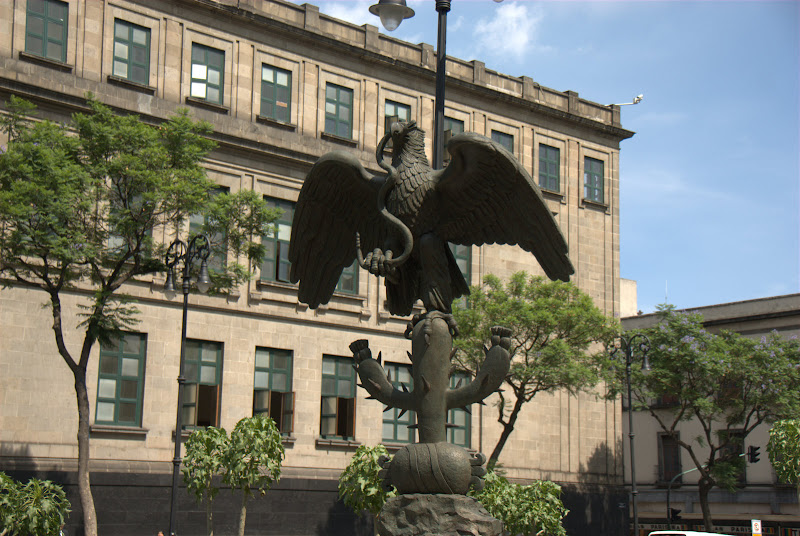


The Aztec built temples to their gods and palaces for their kings. They grew an empire and ruled a city of about 250,000 people until Cortes the conquistador came to visit in 1519. What transpired between Moctezuma and Cortes left the population depleted and the city razed to the ground.

The Spanish proceeded to build their on city on top of the remains and this is what the center looks like today.
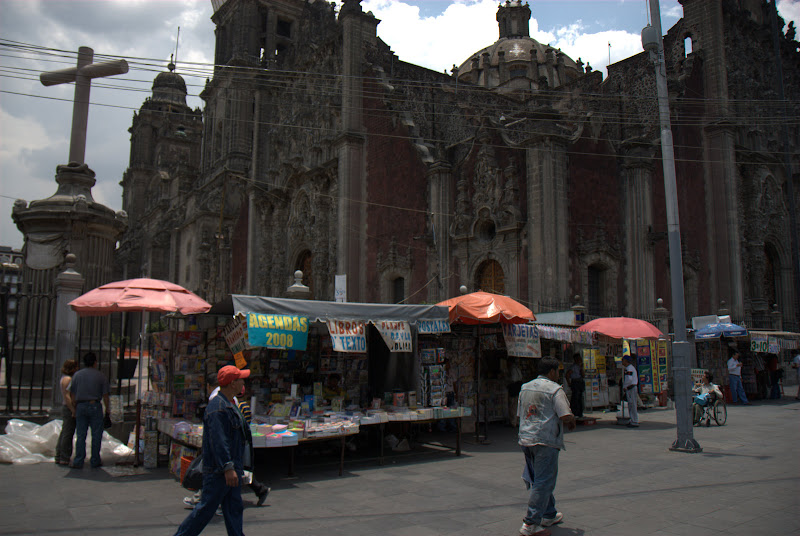


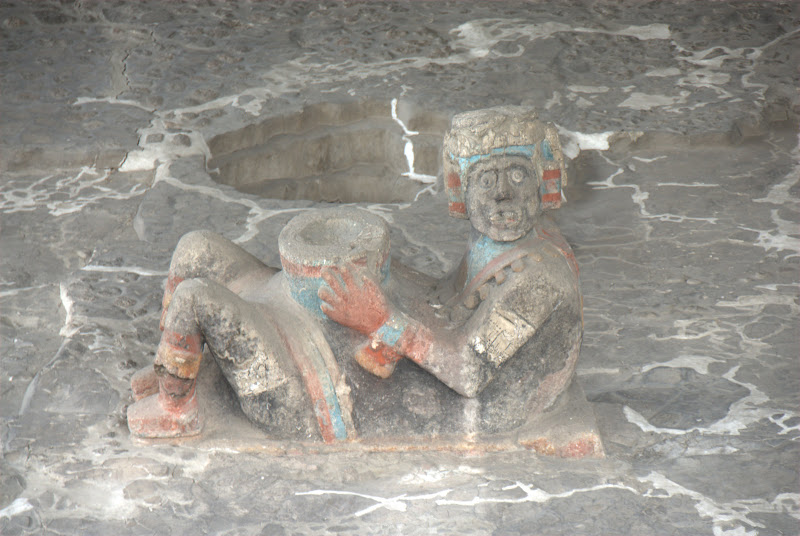
During a construction in the mid 20th century, workers came upon a large statue of a god and the authorities decided to dig. What was discovered, right next to the cathedral, were the remains of the main temple. The temple was mostly destroyed when the Spanish took over, then turned into a garbage heap. There was not much above street level, but you can see in the pictures the different phases of expansion of the temple (each king's ego begets a new wall), and some of the statues that remain from that time. The original temple had two altars at the top where human sacrifices were performed and the heart placed in this surprised guy's cup.


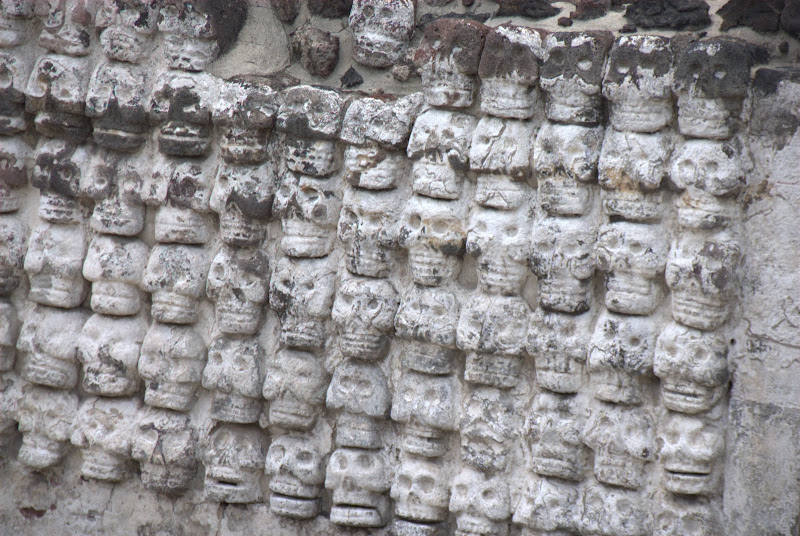
You can also see the shrine to the underworld, this wall of skulls.


It's interesting to see the temple along side the old cathedral and the more modern building surrounding the main square.
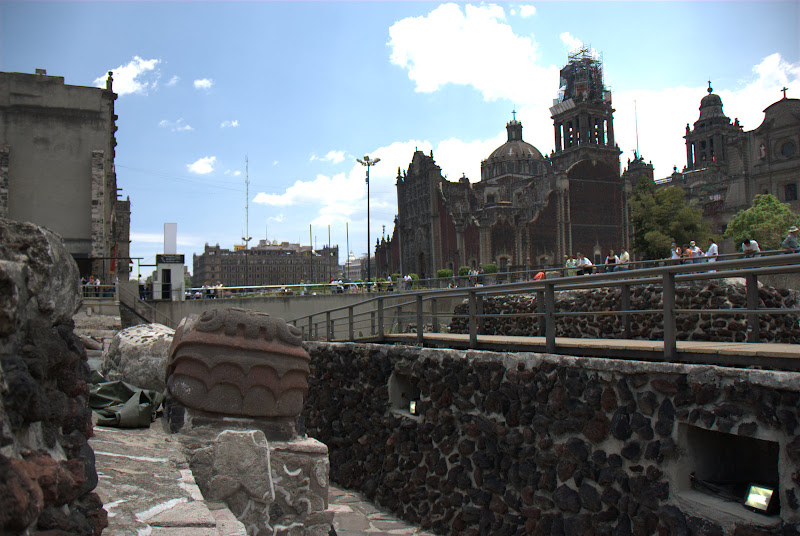


This place, according to Aztec tradition, is the center of the world. I'm intrigued at what religion doesn't believe it is situated near or at the center of the world.

Subway Etiquette

There are a number of dangers in Mexico City. Foremost is traffic - watch where you're going. Next is pick pockets looking for your spare change so always separate your daily money from your credit cards, wallet, etc. Then there's kidnapping (about 4 a day in the city). My solution: sit down if anyone tries to kidnap me and let's see what they'll do then.

Then there are the taxis. Specifically, the driver takes you somewhere where his friends jump into the cab and they rob you at gunpoint. Only take taxis recommended by establishments or ordered by phone. Except for to and from the airport, I only used the subway.

Mexico city's subway will take you all over the city with only one thing you need to worry about: Don't take line 1 east during rush hour.

A couple of years ago I was in Toronto, Canada and I took the subway during rush hour. It was winter so I was bundled in a heavy coat and had a backpack. Standing in the doorway of the cabin, I took up a good chunk of the door. When the train stopped people moved around me to get out. I had earphones on so it took me a while to realize that they were grumbling quite loudly that I should step down to let everyone out, that I was a jerk, etc., etc. But none of them asked. Not growing up near a subway it didn't even occur to me.

Now in case you ever find yourself in Mexico City, let me give you some hints on south-of-the-border subway etiquette. It took me a couple of days to undersand that being the first to stand near the door before the train stops does not guarantee being the first to get in. Reflexes and speed matter, as well as what space the people coming out of the train leave.

But when rush hour hits, and no one gets off the train, the story changes. Groups of people congregate where the door of the train will be. When the train stop, everyone starts pushing into the train, with the first people trying to push through the already sardine-packed doorway. The cabin is considered full when there's no space to move and only the people at the doorway need to hold themselves in place so that the internal pressure does not push them out. As the door closes they suck their stomachs in.
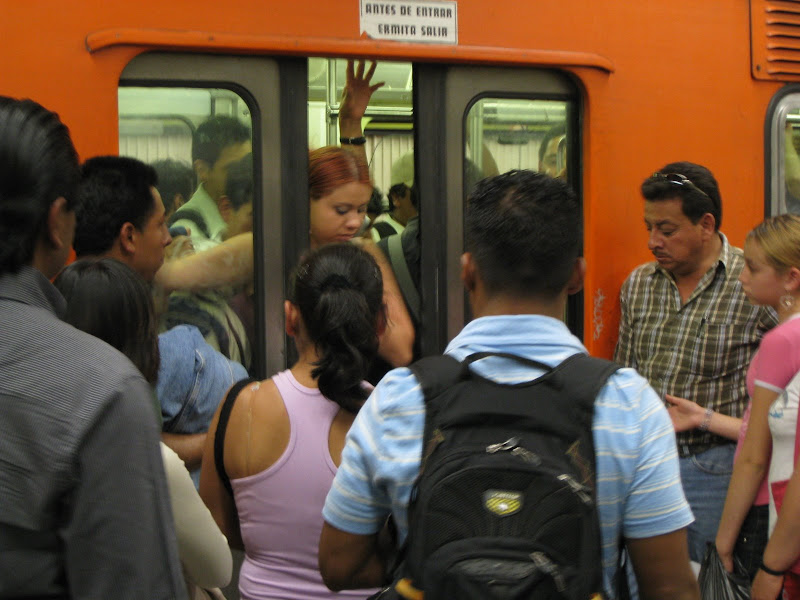


Needless to say it took me 4 trains before I managed to get on - it was a relatively empty train. I made my way to the back to have a bit of peace from all the pushing. Unfortunately at the next stop we stopped for close to 40 minutes and by then we were completely full. Or so I thought, until the next stop a couple of men got onto the train by taking a head start and jumping into the on-board crowd, forcing their way in.

Now you may think getting off is easy with all these people on board, but let me tell you, careful planning is required. As we stopped at the station I needed, I started pushing through the crowd to get out. While people will wiggle around to give you a bit of space, no one would get off the train. (They haven't met the grumbling Canadians). Add to that the stream of people pushing right back to get in and you get stalemate. After a couple of minutes of pushing, the train's doors closed and I was still 2/3 away from the door (I was standing opposite the door when we stopped). The next stop got me halfway across. By the next stop, everyone realized I was trying to exit the train. While no one would move for fear of losing their spot, they were certainly helpful. And so, as the door opened, a couple of guys behind me started pushing, helping me "fly" out of the train.

Teotihuacan
Some 1900 years ago, the ancient city of Teotihuacan was at its highest. It's unclear who built the city. It's not attributed to the Aztec nor the Toltec since both cultures came later than the city's fall. The city at its height was bigger than any european city of its time.

The city is divided into four sections by two perpendicular avenues, the longest of the two called the avenue of the dead by the Aztec, since they could not imagine how men could build such huge buildings. Instead, they assumed it was the gods who built tombs for the men of old.


The city's most impressive features are the pyramids of the Sun and the Moon, dominating the view throughout the avenue.
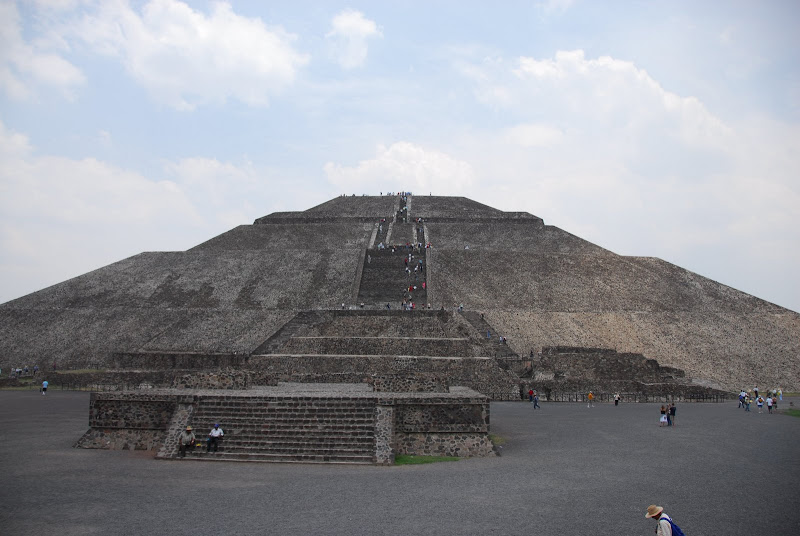


The pyramid of the Sun is the 3rd largest in the world, after the Egyptian Cheops pyramid and another pyramid in Mexico. It's 222m to a side, 70m high (230 feet). It was built around 100AD and if you find that amazing, consider that the local culture had no metal, no pack animals and no wheel.

What they lacked in technology, they made up for in very tall steps. And I bet you they could sprint to the top.

Interestingly enough archaeologists now think the pyramid may have been in honor of a water deity, not the Sun, due to the moat that originally surrounded it.

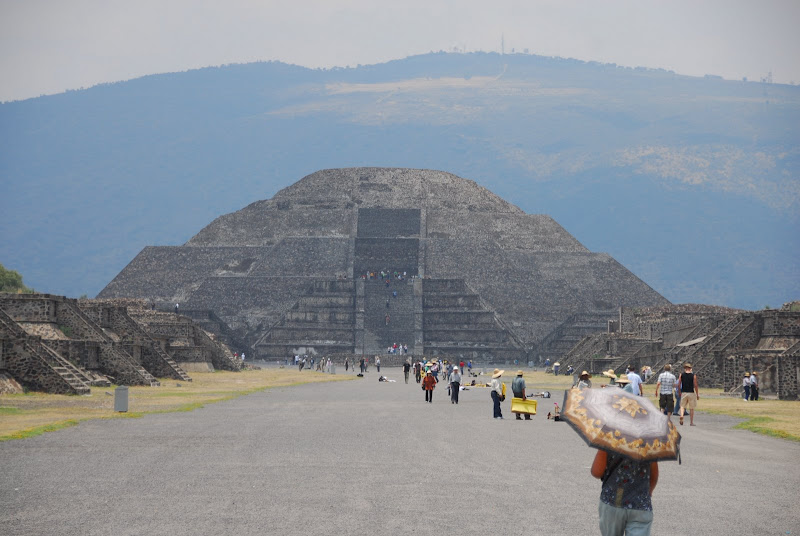
The smaller but more impressive is the pyramid of the moon which you can approach along the avenue of the dead. Surrounded by other temples, it looms above you as you approach.


Boats and Magic and Dolls, Oh My!

I spent one day going to markets and looking at how the locals shop. While the Merced market is huge and spans a few blocks, it is not interesting except for the puzzle it holds for the first time visitor. Once you exit the metro station, can you ever find it again? The building is not visible from outside since stalls are arrayed around it and you have to ask or guess to stumble into it.

Next to it is the magic market, or Mercado Sonora. Stalls sell many kinds of herbs and powders used in local magic. A few stalls also specialize in imported magic. Take this stall for example where you can find Christian and Jewish symbols, angel-of-death figures, baby dolls and trolls.
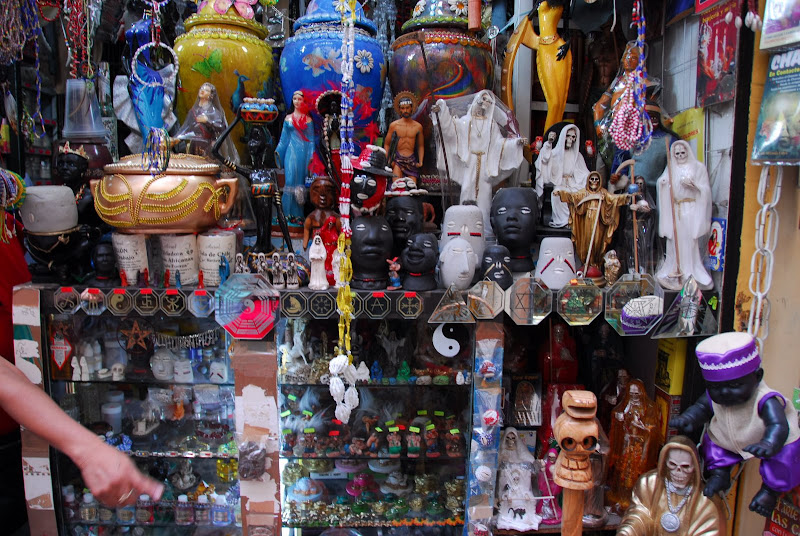


yes - trolls. Ugly as hell trolls. I bought 20.


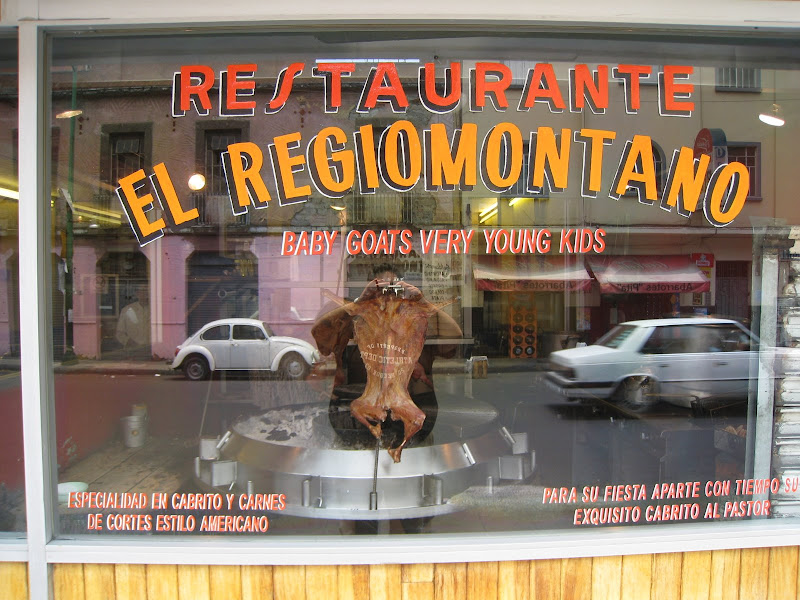
I've also reaffirmed my belief that Mexican food south of the border sucks. The American version is much better, something I wouldn't say about many other americanized ethnic foods. Even following recommendations from the guide, I only found one place I'd go back to to try out other dishes. On the other hand, can you tell what's being served in this place:


To add the obligatory (and always relaxing) boat excursion to this trip, I traveled to the south of the city where what's left of the original lake can still be found. The area, called Xochimilco, is still farmed by the locals. The process involves scooping mud from the lake and concentrating it in an area that then becomes an island. The island is fenced with wire so that the mud doesn't leak out too quickly and this becomes a field.
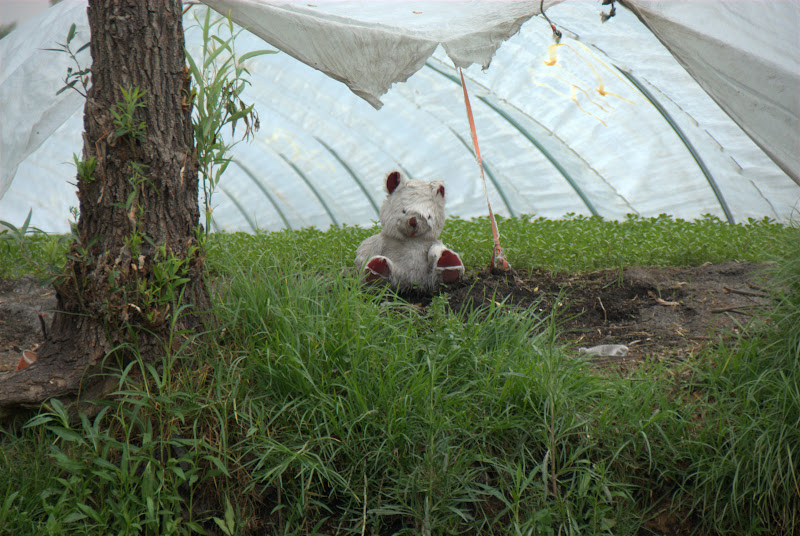


Flat boats sitting around 20 people are available for hire in the channels left by the fields. The boat has a long table, chairs, and a boatman. You bring your own food and drink and slowly float along the canals, being propelled by the boatman using a very long pole. I'm sure I didn't pay enough for the 3.5 hour ride he took me on, so I helped a bit.


Pepper and I (because I finally remembered to take pepper out of the suitcase) anxiously awaited our visit to La Isla De La Munecas [sonido del trueno], also known as The Island of the Dolls [sound of thunder].
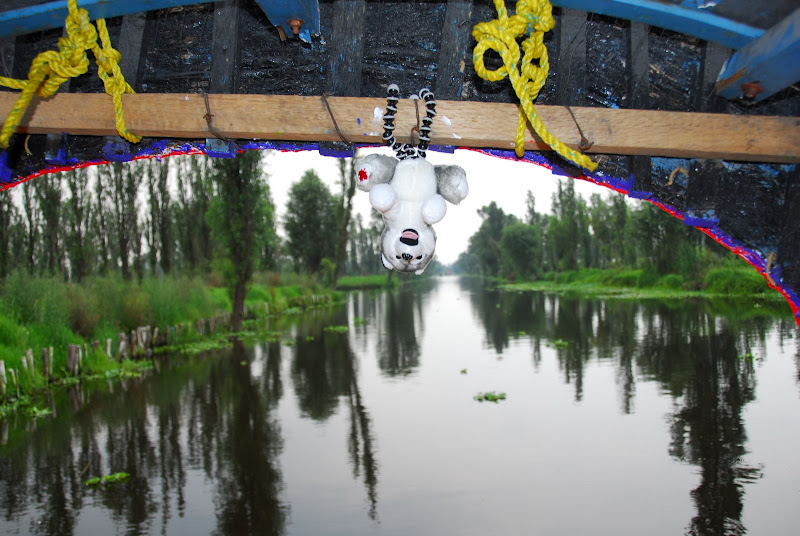


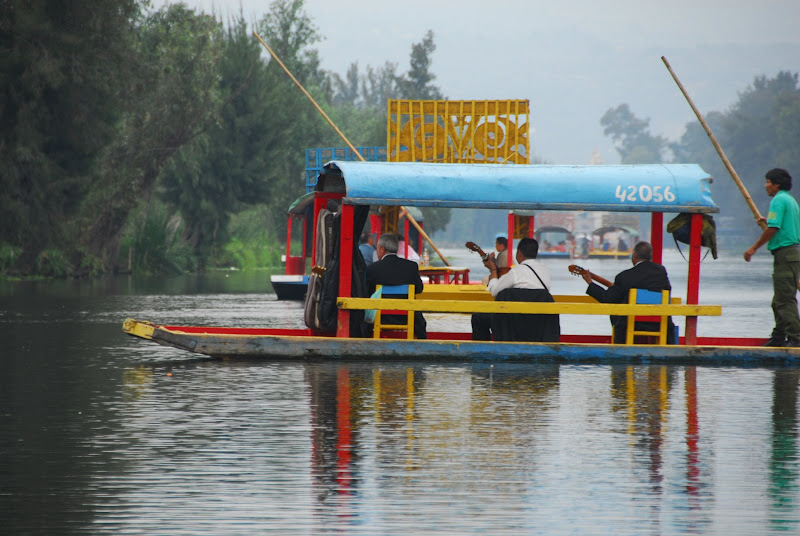
Life comes your way on the lake, and you can find boats with food and drink and even boats where for $5 this trio will play a song for you.


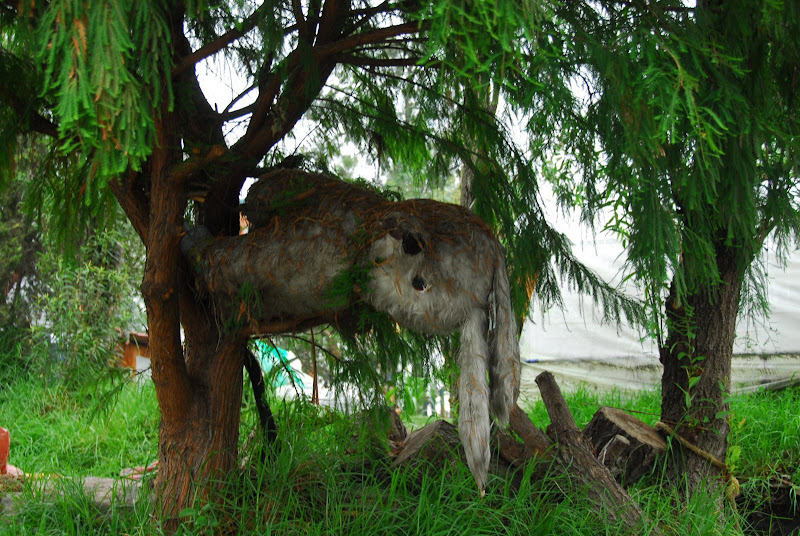
But we were set on getting to The Island of the Dolls [sound of thunder]. The first glimpse of it was this vicious camouflaged guard rabbit.


And then we were there, the The Island of the Dolls [sound of thunder]. Climbing out of the boat you could feel the atmosphere getting heavy with the spirits of dolls past. Welcome to The Island of the Dolls [sound of thunder].
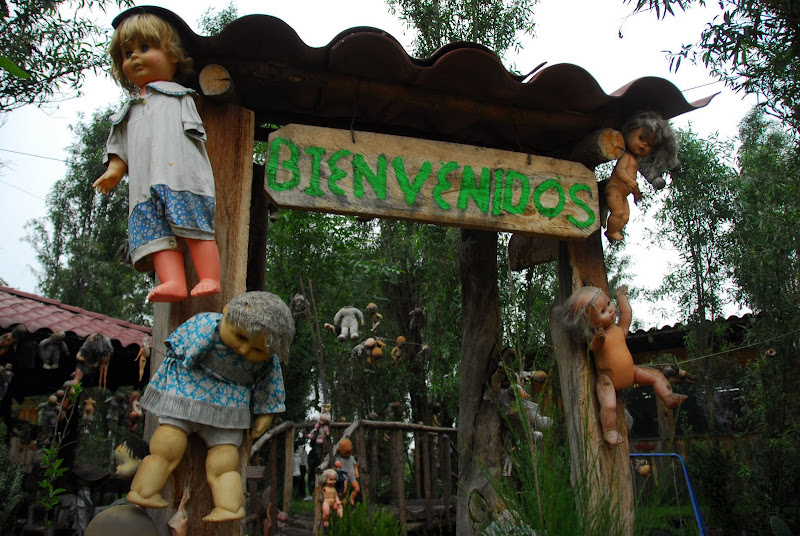


The island's eccentric (read screwed up in the head) owner, Don Julian, believed his island was haunted by a spirit. In order to appease it, he fished dolls out of the water and hung them on trees and in cabins throughout his island. The dolls where not maintained and the atmosphere is decidedly gruesome.



And when you step into the little cabin where the Spanish-only explanation said lots of words I didn't understand, there was Chucky, looking over his domain.
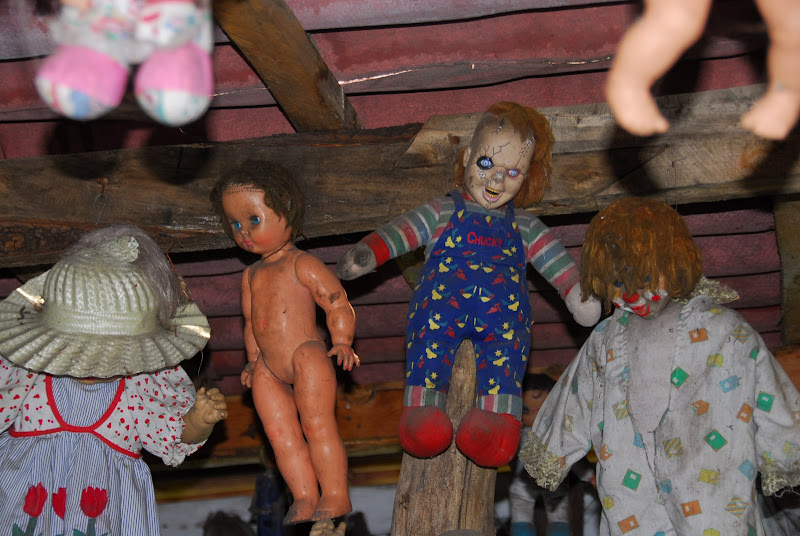

Needless to say Pepper hung out with some of the dolls before we sailed back.



Full album at:
MexicoCity08


Technorati Tags: , , , , , ,

Del.icio.us Tags: , , , , , ,